The U.K.'s Eurovision Entry Says Look Mum, No Computer
The 2026 Eurovision Song Contest is back and political as ever.


It is with no small amount of irony that the Eurovision lineup for 2026 was completed two weeks after the first shots of what may very well turn out to be World War III were fired. The European Broadcasting Union (which produces the annual singing contest) spends part of each year claiming to anyone who will listen that the event is not political. However, the entire point of the exercise, when it debuted 70 years ago, was to serve as a deterrent against WWIII. It was more aimed at helping bring the nascent idea of a European Union into being, a form of cultural exchange using music as a common language, as much as it was a reaction to the tension of the atomic age. In short, its inception was inherently political.
Seven decades later, Eurovision is still the quickest way to take the political temperature across the pond, both in the very biased Jury vote point spreads and the corresponding wave of popular votes, which can (and do) override them. In a year when global hegemony is being radically realigned, let's check in and see how things are faring.
First things first: Spain, Ireland, Slovenia, the Netherlands, and Iceland are boycotting the show completely over Israel being allowed to compete. That's huge, because Spain is one of the "Big Five," aka the countries that actually fund the contest. Unfortunately, at the time of the announcement in December 2025, the Gaza situation had receded from the headlines, and the EBU chose to let Israel (and its Moroccanoil money) return, so viewers will once again face the question of whether or not to sit this one out. That makes this year's lineup slightly smaller than usual, with 35 countries competing out of a possible 42.
(This has – rather predictably – blown up in the EBU's face with the current crisis. As hostilities increase, the pressure to not make that mistake again will be much higher for 2027, especially if this does turn into a full-scale World War.)
Second up, there are new changes to voting regulations due to the boycott. The 2025 contest was nearly derailed by an appeal by Israel to the Jewish diaspora to vote for its contestant; coupled with what is now the first of multiple boycotts of the show in recent times, Israel came far closer to winning than anyone was comfortable thinking about too closely.
The result is that the popular vote has been sharply reduced, from 20 to a maximum of 10 votes per person. Professional juries will return to the semi-finals after last year's "popular voting only" experiment, and will go back to being a 50/50 split with the popular vote. Finally, stricter regulations banning government-backed promotion campaigns have been put in place. Whether or not they are effective remains to be seen.
The reduced popular vote has been something the EBU has needed an excuse to do since the introduction of non-participating countries being allowed to vote. With the notable exception of last year's contest, the popular vote has overwhelmingly negated the jury's preferred choices since the pandemic, effectively neutering them, something the contest producers cannot have been happy about.
Moreover, the entire point of expanding voting to non-participating countries was to increase mainstream American engagement with the contest. After Australia was successfully added to the fold for the 60th Anniversary edition, there was an obvious eye towards inviting the U.S. to join as part of the 75th anniversary. Needless to say, that is obviously no longer on the table.
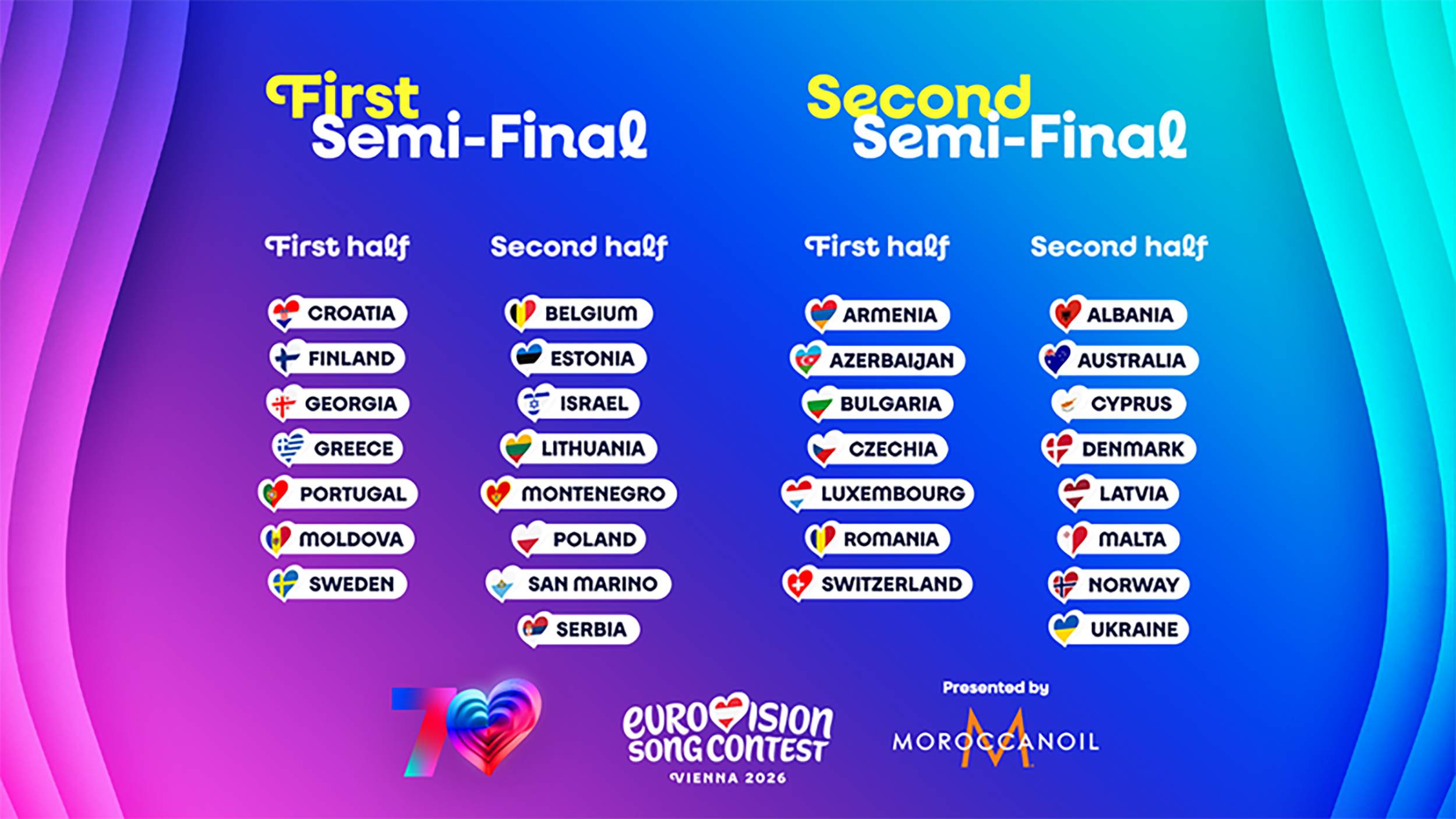
As for the lineup, the boycottees, through no fault of their own, have wound up working in favor of even numbers for this year's contest. With Spain out, the Big Five are back down to a "Big Four" for the first time since 2010; Austria also gets a direct pass to the Grand Final as the hosting country. That leaves an even 30 countries to be divided equally across the two Semi-Finals.
The final running order has not yet been announced, but we should note that the Big 4 and the host country will continue to contribute live performances to the semis, so that viewers can become familiar with them. For 2026, Germany and Italy will perform and vote in the First Semi-Final; Austria, France, and the U.K. will perform and vote in the Second Semi-Final.
But the most interesting developments aren't these top-level moves, but what the general population has voted to represent them. For the first time since 2016's twin Brexit/Trump debacles, English is making a comeback, with 22 countries performing songs at least partly in English, a sharp reversal from the last few years when native languages were all the rage.
As if sensing an opening, the U.K. got its act together enough to send something decent to the contest. Americans might be slightly befuddled by Look Mum No Computer's "Eins, zwei, drei," but counting songs in foreign languages is a whole contest subgenre, and this is not a bad entry into that particular pantheon.
Not that anyone expects the U.K. to win – if there's one thing the popular vote makes clear, it's that there's still a lot of resentment toward the entire concept of Brexit. (Also, no one votes for Australia since it's not a European country, a reminder that the contest producers can only hold so much sway.) But any year the U.K. doesn't send a complete embarrassment of an entry is a good one, even if it winds up being the year where the politics finally drown out the music.
The 2026 Eurovision Song Contest Semi Finals will stream live on Peacock in the U.S. on Tuesday, May 12, and Thursday, May 14, 2026, at 8 p.m. BT/3 p.m. ET. The Grand Final streams on Saturday, May 16, 2026, also at 8 p.m. BT/3 p.m. ET on Peacock.