The Penultimate Pair of Episodes Brings Back ‘Outlander’s Mastery
“There is nothing lost, but may be found, if sought:” 'Outlander' Season 8, Episodes 7 & 8: “Evidence of Things Not Seen” & “In the Forest.”

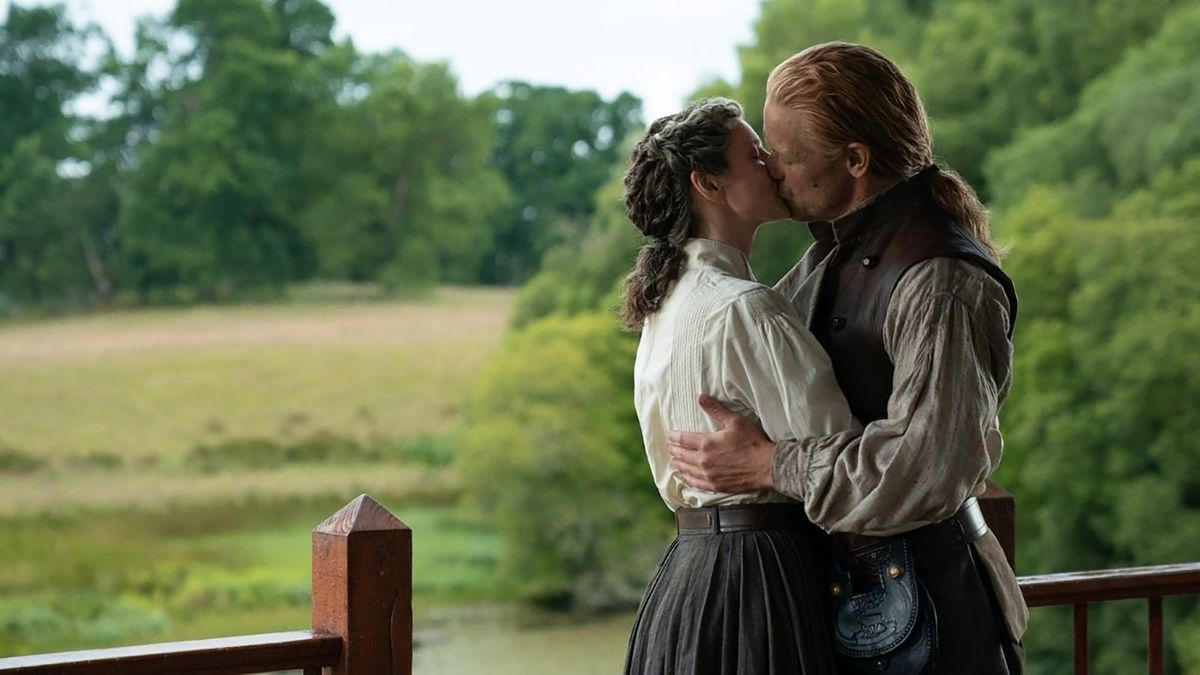
“‘And when my body shall cease, my soul will still be yours, Claire—I swear by my hope of heaven, I will not be parted from you.’
The wind stirred the leaves of the chestnut tree nearby, and the scents of late summer rose up rich around us; pine and grass and strawberries, sun-warmed stone and cool water, and the sharp musky smell of his body next to mine.
‘Nothing is lost, Sassenach, only changed.’
‘That’s the first law of thermodynamics.’ I said, wiping my nose.
‘No,’ he said, 'That’s faith.’” (Gabaldon, Drums of Autumn, Ch 16, p 263)
We are coming to the end of a very long, far-flung, time-traveling journey, to be read in nine nearly 1000-page books, seen and heard in eight seasons, 101 episodes altogether. These two begin the final closure. As Season 8, Episode 7, “Evidence of Things Not Seen” begins, Jamie Fraser, sharing in, while he is dramatizing our anxiety, is climbing all over, checking out a certain lush green steep slope to see if it matches the description in Frank Randall’s book, The Soul of a Rebel: The Scottish Roots of the American Revolution. It informed Jamie that he will soon die here. We hear in voiceover, Sam Heughan and Tobias Menzies’ voices in turn, considering, retrospectively, the moment to come.
Expressed another way, the episode’s theme is “Of Lost Things,” uncannily echoing the title of Season 3, Episode 4, where, more than 20 years ago, Jamie was a groom in the Dunsany family household. He was pressured into having sex with (and, in consequence, impregnating) their older daughter, Ginevra, who gave birth to a son. William (played then by Clark Butler and now Charles Vandervaart) would no longer be lost if he would only accept his two fathers: Lord John Grey (David Berry) through informal adoption, and biologically, Jamie. Signs of what’s to come, and has been, accompany this episode of losses, poignant and tragic.
Among the poignant losses is a square of lace that Fanny (Florrie May Wilkinson, excellent in the role), whom Claire and Jamie have rescued from orphanhood, carries in a cloth napkin. She cherishes it because her grandmother made it for her, and her mother, Faith, gave it to her.
“‘Do ye trust me, Claire?'
‘With my life.’
‘And with your heart?’
‘Always.’
‘Then this will be our home. And we'll call it Fraser’s Ridge.’”
(Outlander, S4, Ep3, “The False Bride”)

Faith, their first baby, whom they assumed had either been stillborn or died shortly after Claire’s too-early parturition in a Paris hospital, has now been lost for good, murdered. Jane (called Pococke) committed suicide at the close of Season 7 after being sentenced to hang for stabbing her mother’s killer. In an echo, Claire also stabs him, killing him, at the beginning of this season. This parallels how Mary Hawkins, many times great-grandmother to Claire’s first 20th-century historian husband, when evidence suddenly reveals a similarly criminal male is the man who brutally assaulted and raped her on a Paris street, stabs him frantically in retribution towards the end of Season 2.
I began to worry (like Jamie) that, rather than hastening together towards perfect felicity, we are moving, unawares, into traumatic shocks. The toweringly tragic, unexpected loss, the episode’s shocking climax, is the death of Fergus (Cesar Dombey) in an arson. A bunch of thugs, using as an excuse the seditious content of Fergus’s printed pamphlets (following in his true father’s footsteps), had been harassing them with anonymous letters threatening to burn his house down. The point of view is his wife, Marsali’s. We had just watched a scene of their joyous lovemaking before sleep; she is now bereft with five children and another on the way.
Fergus’s pamphlet printed the details of Fanny’s life and Jane’s death. Unaware of his medical success and assuming Jamie is about to be executed, Master Raymond, the apothecary (Dominique Pinon), gave their weak, tiny neonate, Faith, to a seamstress living across the street from the Paris hospital. He tells her to take the baby to a Lady Broch Turach, identifying herself by singing “Oh I do like to be beside the seaside,” which the devastated, desolate Claire had crooned. Though the seamstress never found her, Faith grew up knowing the song and sang it to Jane (Sylvie Presente) and Fanny. Thus, across a vast gap in time and space, at age 62 in the American colonies, Claire learns that Fanny and Jane were sisters, Faith their mother, and that these girls were Claire and Jamie’s grandchildren. The music lingering in our ears as the mise-en-scène vanishes and the credits roll is the familiar 1940s beach holiday ditty.

I must admit that I was wrong to be dismayed by the opening sequence of the eighth season. Far from being unprepared for, it is arguable that, in the anxiety to provide emotional continuity, the Outlander team oversauced this episode. But I think not, for its open ghostliness allows us to consciously experience our longing to bring the dead or lost past back to life, one of the functions of historical fiction, with or without the inconsistent fantasies of time travel.
There are thoughts and images which go too deep for tears, of which, in the heights of misery, Marsali shows herself aware; as Episode 8 begins, she stands before the temporary stone circle grave of Fergus, with Jamie by her side, remembering together, as he phrases it, “the son of my heart.” We see a long take from Season 2, Episode 3, “Useful Occupations & Deceptions,” of the newly adopted 10-year-old French boy from a brothel, renamed Fergus Claudel (Romann Berrux), making himself useful by pickpocketing letters to give to “milord” an opportunity to decode them before returning, and by accompanying a pregnant Claire through the Paris streets. Nonetheless, I confess myself near or in tears watching the many scenes of hard-won (all apologies) reconciliation of Season 8.
It takes at least six scenes of self-righteous petulant indignation as only such a privileged, sheltered, lucky 30-year-old William, 9th Lord Ellesmere, son of Lord John, could grow up superficially to be, to get past, forgive, ask to be forgiven, and hug his other father Jamie. I also confess I was relieved when Lord John did not apologize when William interrupted him and his treacherous stepbrother, Percy Beauchamp, who was embracing and kissing. Being William, he produces a scolding rant against his loving foster father as a sodomite. Lord John has to deny that he and Jamie were lovers in Ardsmuir prison in Season 3. So what if they were?

Lord John, a character with a series of novels and short stories in his own right, grows in stature in these later seasons, whose exegesis leads us to material having little to do with Jamie’s life, except that, as is so peculiarly the way with Outlander material, the two men have inhabited the same place at the same time repeatedly. This will include his close congenial relationship with Jamie’s daughter by Claire, Brianna, who matured into a boyishly dressed young woman, a sharpshooter (“Deadeye” was her adopted father’s favorite nickname for her), comfortable with upgrading 18th-century rifles to fire more swiftly. This will take us into the fluid sexuality that characterizes many of the Outlander characters, e.g., her husband, Roger, who would rather read, write, sing, and sermonize than hunt. He is as reluctant to kill or endorse violence as a solution to anything as Ian’s second wife, the Quaker, Rachel.
Rachel directs the angry (at God) grieving Fanny to talk to Roger. His stature as a learned, intelligent Presbyterian minister enables him to persuade Fanny to doubt Jane will forever be tormented and burn in hell for her “crimes.” Meanwhile, Roger finds his and Brianna’s lost son, Jeremy, on a path in 1739 North Carolina while with Bucke Mackenzie, himself a time-traveler and the many-times-great-grandson of Geillis Duncan & Dougal Mackenzie. (Don’t ask. Accept.) As in Shakespeare’s late romance plays (out of 3rd-century Greek novels of wandering and loss), no one in Outlander goes unrelated to someone. All are kin.
The episode ends with Jamie and Fanny standing together over the cairn, which Fanny has built as a grave and site de mémoire for Jane in the grounds of Fraser’s Ridge. It’s where we discover she, too, is a traveler when she asks Jane for a sign, and a gem like those needed to travel through time is there, turns blue, cracks, and buzzes. I needn’t argue specifically that the quality, nature, script, slow pace, mise-en-scène, and l’écriture-femme of these two episodes return us to the masterly achievements of the first three seasons.
Outlander Season 8 continues with new episodes on Fridays on Starz, with the series finale streaming on Friday, May 15, 2026. Seasons 1 through 7 are available to stream.
(For this review I am indebted to two of Valerie Frankel’s collections of essays, The Symbolism and Sources [Celtic, Scots] of Outlander, and Outlander’s Sassenachs: Gender, Race, Orientation and the Other in the Novels and Television Series (McFarland, 2015, 2016); Duane Meyers, The Highland Scots of North Carolina, 1732-1776 (Univ of North Carolina Press, 19610; and John Prebble, Culloden, Highland Clearances, Pimlico, 1961/3)