'Outlander' Undermines Its Origins as a Heroine’s Text

In Episodes 5 and 6, “Send for the Devil” and Blessed are the Merciful,” this reversal is used for the plot design of the whole
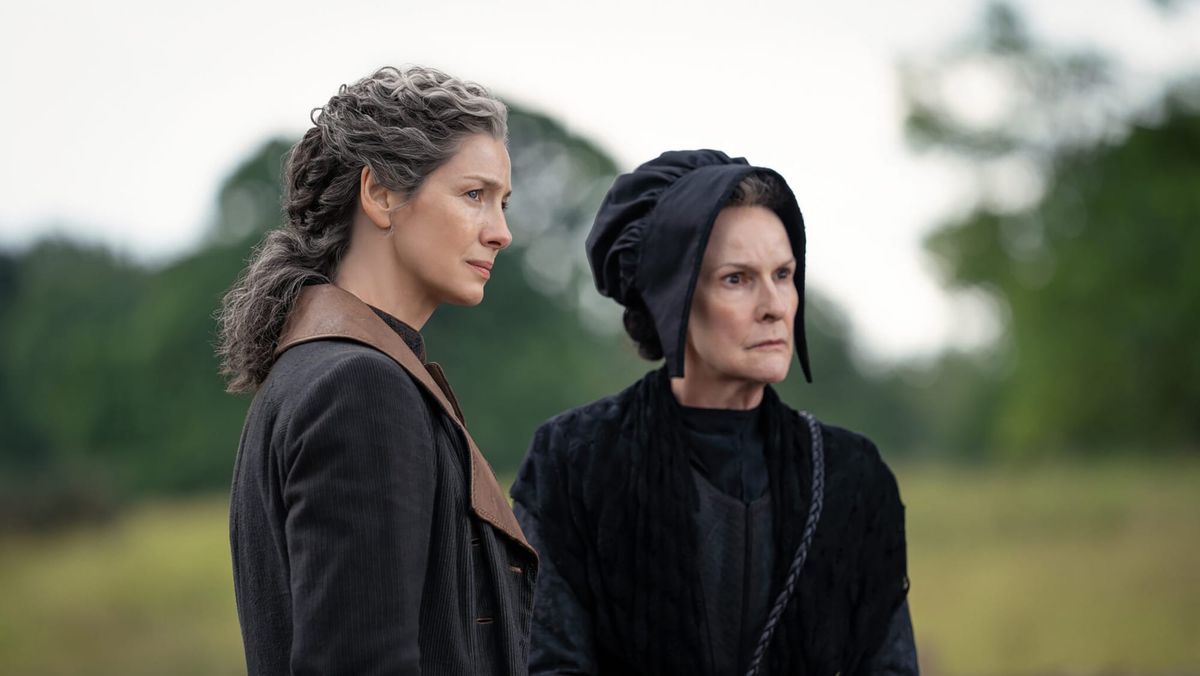
Caitríona Balfe and Frances Tomelty in 'Outlander' Season 8
Caitríona Balfe and Frances Tomelty in 'Outlander' Season 8 (Starz)

As the titles of Outlander Episodes 5 and 6, “Send for the Devil” and “Blessed are the Merciful” imply, the overarching story is a male-centered war narrative, where males seek successful social identities, while the females attached to them are consigned to interludes or attempt to influence or to change the primary male story. What’s different this time (between these two episodes and just about all that came before) is that the male-initiated story takes over the plot design and secondary story lines.

Let’s take a step back to achieve some perspective. What began or existed in summer 2014 were 7 volumes (Outlander, Dragonfly in Amber, Voyager, Drums of Autumn, The Fiery Cross, A Breath of Snow and Ashes, and An Echo in the Bone) of Diana Gabaldon’s historical novel telling from a woman’s point of view the kind of structures and content found in books written for women readers by a women writer (circular, repetitive, romantic, domestic) a central continuous fantasy story of a mid-20th century British nurse, Claire Randall, who traveled back in time 200 years; she went by the force of some magical circle of neolithic stones from Inverness, Scotland, 1945, to Inverness, Scotland, 1743.

Between 2014 and 2021, Gabaldon added two more books (Written in My Own Heart’s Blood, and Go Tell It to the Bees that I have Gone) while a TV company produced 5 seasons of a TV serial video drama, with differing numbers of episodes, under the umbrella name, Outlander, from the first five books. Between 2022 and 2026, the last four had been adapted into three more “seasons.” 
Caitríona Balfe and Sam Heughan in 'Outlander' Season 8 (Starz)

To makes these videos marketable to a male as well as female audience, individual parts of episodes replaced or undermined the female-centered with male-centered matter; on the whole the TV series following the books became a woman’s love story, with an idealized loving male like those found in women’s “romances of the heart,” an 18th century Scots highlander, James Fraser, in an epic-sized historical romance, resting on time-traveling archaeological fantasies, with many archetypical figures, places, things, relationships, patterns and prophecies, which would appeal to uprooted 20th and 21st century middle class individuals, often lonely, alienated, seeking meaningful stable fulfilling lives within a group in a landscape they belonged to, could feel safe in.

Over the course of a decade of the books and films’ actual production, and the internal span of time and distanced spaces and cultures within the books themselves, more than twenty years, the overarching perspective gradually, slowly, took on “board” (so to speak) sexualities other than the heterosexual, cultures other than the modern Western European and American. Yet I’d say it remarkably kept its proto-feminist mid-20th-century, anti-imperialist-colonialist, anti-war perspective (note I do not say anti-violence, for these are American books with a pervasive religiosity), grounded in granular, accurate details and familiar, symbolically gendered things. This groundwork accounts for why the books are so long (around 1000 pages each).

But, as is truly said, all good things come to an end, and we have but four episodes left after these. I found the opening episode of this season dismaying for attempting too much and, in so doing, becoming too shallow, crowded, and uneven, overdoing the emotionalisms of memory, becoming absurd, and sometimes longing to start new developments. Towards the end of Episode 6, at moments of final adieu and gratitude, the characters became too solemn. 

Sam Heughan in 'Outlander' Season 8
Sam Heughan in 'Outlander' Season 8 (Starz)

Were these two episodes turned into a male action narrative to let the writers cover a lot of ground efficiently? Episodes 5 & 6, “Send for the Devil” and “Blessed are the Merciful,” with their male, melodramatic, irreversible turning points and revenges, with plenty of exciting flash, graphic distress, noisy explosions, and unexpected surprises for the restless. These two episodes do dramatize important, lesser-known battles of the American Revolutionary War: there is George Washington, and here, Benedict Arnold.

I must single out for praise Turlough Convery, who plays the historical figure Benjamin Cleveland, a pioneer and officer in the North Carolina militia, serving as a dangerous ally to Jamie. Covery is Proteus-like in the variety of roles he has played brilliantly in these British costume-drama period pieces (from Les Misérables to Sanditon).

To be fair, the two episodes pass the Bechdel test with ease (pairs of women discuss topics unrelated to attracting or coping with men). While the heroic males initiate action, the moral females actively and responsibly shape more benign individual fates. Time travel is still a spiritual pilgrimage, enabling those to find a place where authentic selves can safely flourish. Here, in this bubble, Brianna MacKenzie (Sophie Skelton) has become an effective daughter to the ever-capable Claire, who enables a woman to give birth to twins, one of whom seems stillborn at first. The two episodes feature three mother-daughter pairs and portray women as patient and effective persuaders. (I also love the way she is dressed in the 18th-century sequences.) 

Sophie Skelton in 'Outlander' Season 8
Sophie Skelton in 'Outlander' Season 8 (Starz)

Men may rule, and women influence, maneuver, and deceive for what they want. (Still, I admit that if I have to choose between Amaranthus Cowden as insipid and sentimental or as a sly femme fatale, I prefer the latter.) “Send for the Devil” continued the tradition of echoing scenes from the early seasons, a semi-call back to Season 1 with Lord John Grey’s sheer helplessness before Jamie Fraser, recalling the latter’s in the face of the sadistic Black Jack Randall. (Notably, the sequence lacks the homophobic overtones of the original, also preferable.) The gentling of this, in generating patterned, parallel events across a wide swatch of time (and space), was also clear in Roger Wakefield Mackenzie’s lack of aggression the second time around.

(David Berry and Richard Rankin are two of my favorite actors in the cast, Roger for me a secondary chief narrator in the books, and the disabled Ian a marvelous writer of letters.)

William’s story criss-crosses the episodes, but Roger and Brianna are given the running-into-one-another’s-arms that was the trademark of Claire and Jamie. Of the second generation, the deepest moving moments are Ian (John Bell) and Rachel Hunter’s (Izzy Meikle-Small). Her role as the conventional Quaker woman becomes that of a woman who lives out her principles, makes her will felt, no matter how inconvenient to others. Ian has lived the life of a Mohawk warrior, but she continues to speak out against war. Yet she is always trying to do what is best for him, which will make him happy. Their first love-making scene is sweet.

Izzy Meikle-Small and John Bell in 'Outlander' Season 8
Izzy Meikle-Small and John Bell in 'Outlander' Season 8 (Starz)

Nonetheless, compare this plot design to all of Season 1. Episode 12, “Lallybroch”, is the only episode in the entire first season in which women aren’t in charge. Up until that point, every episode showed women as the ones making formidable demands, strong in mind and in bodily reactions, taking on male roles; it allowed the viewer the pleasures of the book’s home-making, settling in, becoming sisters-in-law, Claire, a useful needed family member with an unusual set of knives (Chapter 12: “Lallybroch”) before the women’s matter was sidelined by a violent male fiasco.

Here, our focus is taken up in “Blessed are the Merciful,” with Jamie and his inability to forgive his tenants, long-time friends, who betrayed him by supporting Cunningham’s Tory-Loyalist plot. As punishment, he says he should eject them, but he doesn’t want to make their wives and children homeless, so he settles on signing contracts with their wives, making them the homeowners. Jamie has become too central in some way.

Thus far this season, Caitriona Balfe is not given near enough for her talent, no chance for the frustration of being nominated for best actress and not winning because, forsooth, who pays attention to women’s romance?

I shall hope very hard for better next week. For make no mistake, I am an ardent fan.


Outlander Season 8 continues with new episodes on Fridays on Starz through the beginning of May 2026. Seasons 1 through 7 are available to stream.

Watch Outlander Online: Stream Full Series on STARZ
Jamie and Claire return to a changed Fraser’s Ridge, facing new threats and family secrets as they fight to protect their home and their future.

(For this one, I am indebted to Suzann Juhasz, Reading from the Heart: Women, Literature and the Search for True Love, Penguin 1995; Maureen Murdock, The Heroine’s Journey, Shambhala Publications, 1990; Maria Tartar, The Heroine with 1001 Faces, W.W. Norton, 2001; Diana Wallace, The Woman’s Historical Novel, British Women Writers, 1900-2000. Palgrave Macmillan, 2005)