Gaiman’s ‘Good Omens’ Finale Revels In Heartbreak
Whose Happy Ending Is It, Anyway?

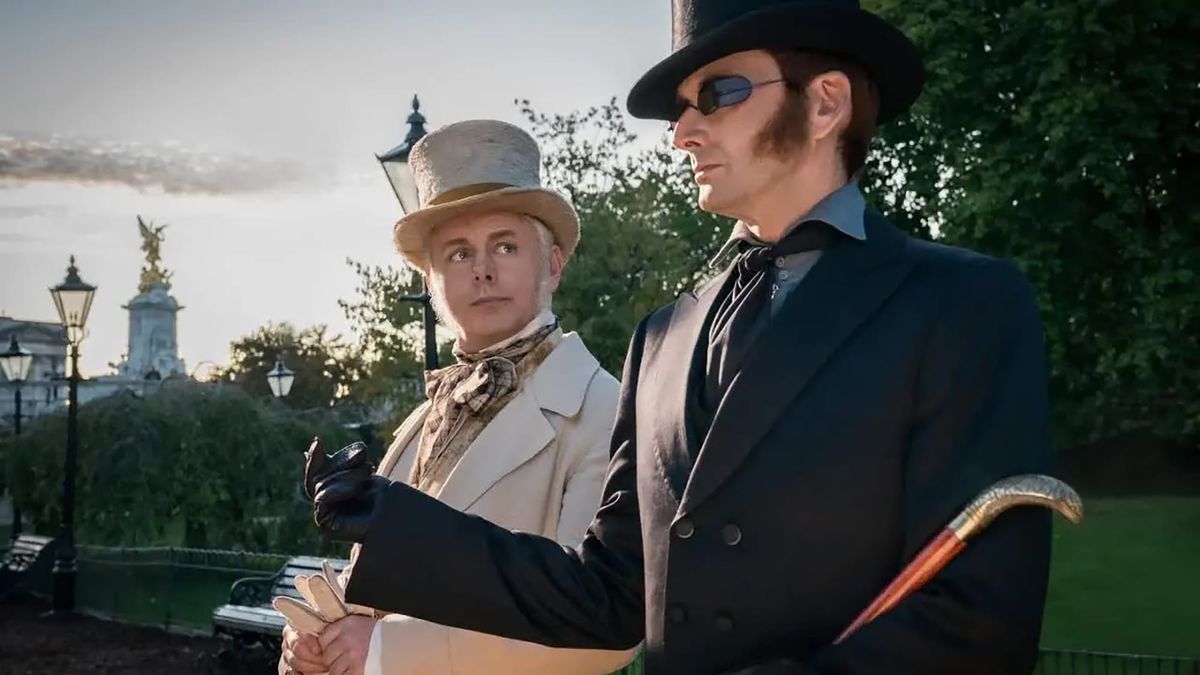
The finale of Amazon Prime’s fantasy series Good Omens was supposed to be a gift to its fans, bringing closure and peace to the love story between the angel Aziraphale (Michael Sheen) and the demon Crowley (David Tennant). How did it end up leaving so many furious and brokenhearted instead?
The final installment of Good Omens (based on the 1990 novel by Terry Pratchett and Neil Gaiman) was more beleaguered than most in the making. After Pratchett’s death in 2015, Gaiman adapted the original book as a six-episode series for Prime, which premiered in 2019. A second season, going beyond material published in the initial book, came to the screen in 2023. The show was then renewed for a third and final season, with Gaiman once again writing. But after multiple people accused Gaiman of sexual assault (allegations Gaiman denies), Amazon relieved him of further involvement in the project. The finale was restructured by writers Peter Atkins and Michael Marshall Smith as a single 90-minute TV movie, based on Gaiman’s original scripts for the third season. Rob Wilkins, executor of Terry Pratchett’s literary estate, remained an executive producer through production company Narrativia.
While all of this cast a shadow over the production, fans remained hopeful that the cast and crew, who clearly loved the story, would salvage the finished product. Season 2 had ended with a devastating romantic cliffhanger; however, Good Omens was a comedy. Therefore, it would follow comedy rules: Aziraphale and Crowley’s parting after a desperate, unhappy first kiss would turn out to be the second-act reversal before the third-act restoration.

There was even a widely shared bit of fanlore about this conclusion: both Pratchett and Gaiman had spoken all the way back in 2005 of Aziraphale and Crowley retiring together to a cottage in the UK’s South Downs. The implication of Season 3 proceeding in this form was that representatives of Pratchett’s estate wanted to see the story through to this conclusion.
In the finale, Crowley and Aziraphale don’t manage to avert the apocalypse (or even come along for the ride while people avert it, as they did in Season 1). Instead, they opt for a new world to exist with no God, Satan, angels, or demons — even them — and they vanish into the Big Bang of a new universe. Billions of years pass. In the present day, we see astrophysics professor Anthony Crowley meet bookseller Asa Fell in London. Twenty years after that, we see Asa and Anthony, married and stargazing under an apple tree in the South Downs. “I have the universe out there, and I have you,” Anthony tells Asa. “I have everything I’ve ever wanted.”
Are Aziraphale and Crowley dead? Fans are divided. Anthony and Asa bear some resemblance to the Crowley and Aziraphale fans have come to know and love. They’re played by the same actors, after all, and Anthony retains Crowley’s red hair and love for the stars; Asa is still a blond bookseller in old-fashioned clothes. But it’s fair to say that the versions of them that viewers fell in love with — Sheen’s Aziraphale, with his worn waistcoat and his gourmand’s palate, and Tennant’s Crowley, with his vintage Bentley, his supermodel swagger — do not get a happy ending. They don’t end up in the South Downs. Their old universe, and everyone in it, is gone. The world they fought for three seasons to love and save and live in is beyond saving, because a cruel God has rigged the game.

The ending may seem surprisingly happy for a tragedy, but it’s a tragedy nonetheless, and a tragedy that hits viewers all the harder for catching them by surprise. Good Omens became so widely beloved because it was a story in which queer love and love of the world in all its possibilities and imperfections were one and the same. An angel and a demon aren’t “supposed” to fall in love with each other, any more than they are supposed to fall in love with the human world. Season 1 showed love as hopeful, joyful, and purposeful, nurturing life, and allowing it to flourish. With the finale, it became a story about how the highest purpose of that love is not flourishing, but sacrifice. Perhaps a sacrifice that pays off, perhaps a sacrifice that allows love to bloom differently—but a sacrifice all the same.
There were many other ways to write the ending. Perhaps, alone in the bookshop at the end of the world, angel and demon create the new world themselves — after all, Season 2 went out of its way to note that when they work together, even something they intend as a small miracle becomes an astonishingly powerful one. Perhaps they openly avow their love at last and embrace, and their love restores everything they have lost. Perhaps Aziraphale and Crowley aren’t the last ones standing — instead, humans themselves are the ones who avert the apocalypse. Perhaps the reincarnated Jesus, being both divine and human, has some say, rather than collapsing into dust at the end. Perhaps, as the original book itself suggested might happen, the final battle is between those who wish to destroy humanity and those who wish to preserve it.
So the ending we got feels like one final, ugly power trip by Gaiman, a statement to viewers that the highest and best use of the love they bear for these characters is for it to be sacrificed to the needs of the plot, dictated by the author-God for his own purposes. Crowley and Aziraphale’s love, and the viewers’ love for them, are manipulated and used against them to inflict emotional pain. Gaiman always sold the continuation of Good Omens as a tribute to Terry Pratchett, based on the conversations they’d had about a potential sequel book that never came to fruition.

While there are some plot beats that feel like they might have belonged to Pratchett originally, you can tell who wrote this script. Pratchett wrote to share a story with an audience; Gaiman has written to subject the audience to his story. The love brought to the show by cast and crew softens the blow, but it doesn’t avert it. Pratchett may have wanted angel and demon to end up together in the South Downs, but more than that, he’d never have wanted to trick the audience for a storytelling ta-da.
If this finale is a love letter to fandom and fanfiction, it’s a love letter to the ability of fans to create better stories for these characters than the ones they canonically got. Not just happier stories, but better stories—ones that pay off the themes of the original work with more care and love than their author gave them. Ones that use our own free will to say, “Here’s how this story goes.”
All episodes of Good Omens and the finale film are streaming on Amazon.
(We occasionally use affiliate links in our posts to help keep cat food on the floor.)