‘Outlander’s Finale Asks: Have We Come to Journey’s End or Not

It’s taken 12 years, eight seasons, 10 novels, not to mention four related Lord John novellas, assorted stories, and a graphic novel to tell this many-decade multi-plot saga.
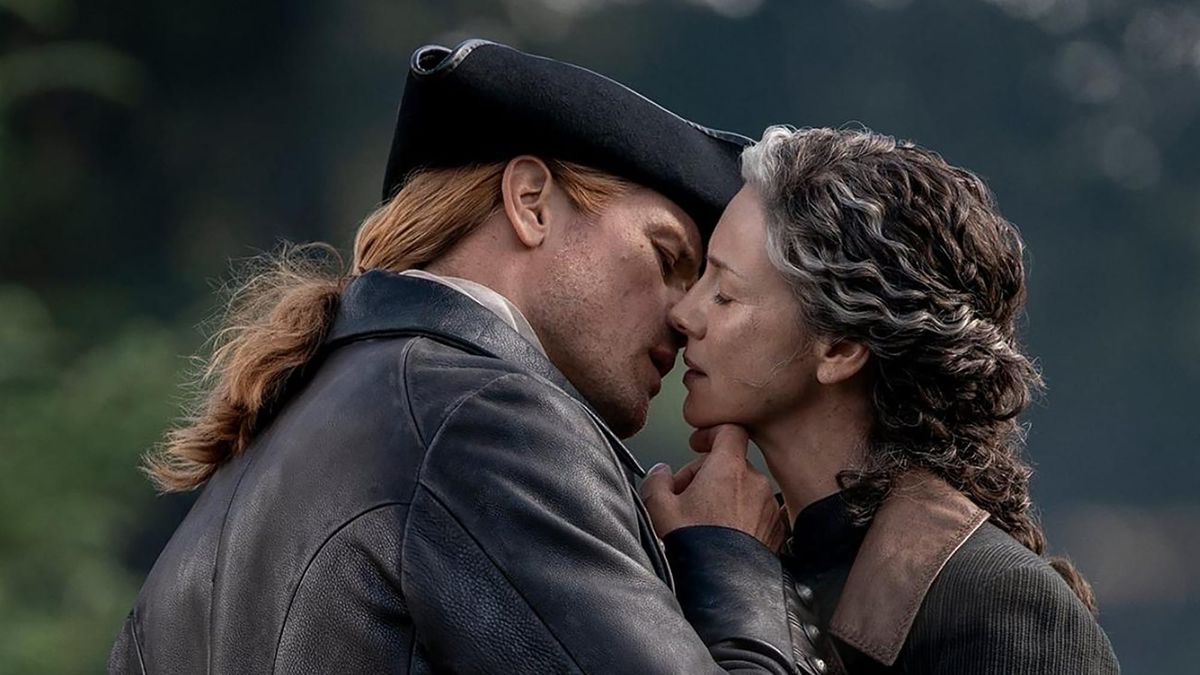
‘Outlander’s Finale Asks: Have We Come to Journey’s End or Not
Sam Heughan and Caitriona Balfe in 'Outlander's series finale (Starz)
Nine bean-rows will I have there, a hive for the honey-bee,
And live alone in the bee-loud glade.
And I shall have some peace there,
For peace comes dropping slow
Dropping from the veils of the morning to where the cricket sings                              
-William Butler Yeats, “The Lake Isle of Innisfree” 

Well, we’ve had a long journey of it, whether you began by reading in 1991, the first novel, Outlander, or by watching, from 2014 to 2015, the 16 episodes of the first season, Sassenach. It’s taken 12 years, eight seasons, 10 novels, not to mention four related Lord John novellas, assorted stories, and a graphic novel to tell this many-decade multi-plot saga.

With the announcement of the final episodes, suspense has been reinforced by Brianna carrying a 21st-century present for Jamie: Frank Randall’s Soul of a Rebel, The Scottish Roots of the American Revolution. Frank predicts Jamie’s death at Kings Mountain through voice-over, and becomes revenant in flashbacks (Tobias Menzies is fittingly there). 
Sam Heughan and Caitriona Balfe in 'Outlander's series finale (Starz)

The Patriots seem to have won; the other side was ceasing to fight, giving up arms, so Jamie goes over to where Patrick Fergusson (Charles Aiken) lay wounded and captive and asks him to concede. Defiant, Ferguson shoots Jamie with a rifle directly into his chest. Then Jamie was collapsing, staggering, weak, and we saw an enlarging, thickening wine-dark spot, where Jamie’s heart would be. Camera shot further off, and we saw bubbling up and out of Jamie’s mouth thick blood, over his heart, Claire now there, screaming, crying, frantically taking instruments from her bag, stretched out over him, her hand on his heart pushing to stop the bleeding, restart the breathing, weeping copiously, mouth wide open. Another shot, overhead, the two lying side-by-side on a standing stone laid flat, an altar or cradle-like curving up like one of those flowers Claire had told Jamie of the night before, where two loving bees, lying dying, nestled inside, the bees’ feet entwined.

Ian nearby, speaking tenderly, John Bell’s boyish “Auntie...”  Roger is also now there, slightly authoritative: “Claire, it breaks my heart to say this... he’s gone.” We watch them lie there, she enduring the hours of the night. Dawn. In this morning light, traumatized, exhausted, her arms around him, Claire’s hair has turned white. Then, for a split second (you’d miss it if you turned your eyes away), the viewer sees their eyes open, maybe they observe all around them, then shut, and the screen goes dark.

Sam Heughan and Caitriona Balfe in 'Outlander's series finale (Starz)

 The filmmakers played coy with the audience. Gabaldon’s self-reflexive remarks in interviews suggested they were concerned with intriguing us, keeping our interest alive while providing closure, without seeming manipulative. The producers knew many viewers had invested so much in these imagined individuals and lives; they had to be respectful of precious feelings.

A second, unexpected death already occurred at the end of Episode 9, “Pharos.” I, for one, felt intense shock when, just as Fergus (Cesar Dombey), the “son of [Jamie’s] heart,” seemed to be successfully rescuing his young sons and himself from an arson attack, the roof he was standing on collapsed. A howl from Marsali (Lauren Lyle), camera now on her face, as she stands witnessing this reversal from down below, then sitting all night on a bedroom floor, silent, dry-eyed. 

The finale, “And The World Was All Around Us,” begins with the scenes matched: Marsali graveside with Jamie, saying she is glad to have something more of Fergus in another child on the way, vowing to stay, take Fergus’ place, and know a freedom not possible for her in the highlands. She is seen as a master artist working at a complicated spinning wheel.

Caitriona Balfe in 'Outlander's series finale (Starz)

In Season 4, Adewehi, a Cherokee healer (Tantoo Cardinal), had told Claire she would reach full healing powers when her hair “turns white.” In the Season 7 finale, Master Raymond (Dominique Pinon), the Parisian apothecary, appeared before Claire, asking forgiveness, suggesting that through Claire, Faith had been “recalled to life.” How much of this Dickens kind of thing most readers can tolerate, I know not. (For myself, a little goes a long way.) We can charitably see this as a means to provide a path to an imagined future for Jamie and Claire in that “bee-loud glade” of Inisfree. (Jamie cites lines from Yeats’ poem twice.)

In the meantime, let us take in the two marvelous final episodes of our wondrous multi-plot decades-long story to see what such a future might hold. Episode 9’s central character, its linchpin presence, was, justly, Lord John Grey; its motif reconciliation. Characters from the Lord John books thicken his presence, and he behaves with the same ideals of his older brother, Lord (Hal) Melton; instead of accepting Jamie’s offered forgiveness for bedding Claire, he (and then she) demand appreciation of all they have given Jamie.

I was as moved by William’s acceptance of John as his father. I smiled happily to see Jamie and John sit down to play another chess game as a final challenge. William emerges as a grown-up at last, in command of himself. When Amaranthus asks him to marry her, he’s tempted, but declares he does not love her. She’s a natural as Lord John’s daughter-in-law in his household; her son by Ben, John’s biological nephew, is already providing him with a grandson.

David Berry in 'Outlander's series finale (Starz)

I enjoyed the richness of the episodes’ untangling of relationships, though I was dismayed by the underlying endorsement of violence as a solution to problems. The script aims to make John heroic by having him kill Ezekiel Richardson, leaving him no chance to expose Percy Beauchamp. Against this pious cant tribute to self-control, Turlough Coventry, as Benjamin Cleveland, is again memorably effective, as a ruthless male Fate, as he calls out Jamie to fight alongside him at Kings Mountain. His versatility is remarkable; his previous roles in Sanditon and Les Misérables make it all the more fun to watch him swagger.

The penultimate episode is full of deep cuts for lore enthusiasts, recalling details of past finales, while the finale itself uses flashbacks, voice-overs, and montages to become so vividly retrospective. My heart was full by the time the telltale progress bar was matched by a vatic tone. Loose ends were neatly tied, variously parented by Jamie and Claire, as they cope with the dread of what’s to come. Seasons 7 and 8 included a third era (the 1730s), enabling some to encounter many great-grandparents, including Roger meeting Geillis Duncan (Lotte Verbeck) and Dougal Mackenzie (Graham McTavish). 

I felt the scriptwriters sidelined him and Briana with the end of that plot thread, for fear of overshadowing the central Claire and Jaime. For me, there was a little danger; Roger is a frequent narrator in the novels. But they return in the end, foreseeing that if Jamie dies, the three of them have such deep emotional roots in this era that they would prefer it. As Claire says, their homes (Lallybroch and Fraser’s Ridge) keep him alive all around her. 

Charles Vandervaart, Sam Heughan, and Caitriona Balfe in 'Outlander's series finale (Starz)

The last third was all battle until victory felt snatched out of their hands when Jamie falls. I thought the battle was superbly realistic, enough so that the waste, destruction, and senseless barbarity felt in line with our experience of Season 2’s pyrrhic win at Prestonpans and the slaughter at Culloden in Season 3.

I regret the decision not to leave these two characters in an austerely sublime realm where nothing is to be questioned. If the horrors of war were to kill Jamie at last, his luck run out, so be it. If he and she were to be parted (as the words of the marriage ceremony tell us must happen, “until death do us part”), let us play no games as if this were a 1930s puzzle mystery with clues. 

It was not the ambiguity but the way it was achieved that I objected to. Genre matters, and time-traveling can end up having to confront science fiction’s nonsense. (I cannot make sense of the preposterous idea that countless eras are all unfolding at once. Surely, everything must at some point rewind lest all crumble into dust.) This tipped into suggesting that death is not permanent. A genre that doesn’t take death seriously cannot comment on human life for real, for it is our awareness of the imminence of death that gives us the hardness and quality of our choices. It’s what makes hope so precious. But I walk away lest there really be spoilers here. 


All seasons of Outlander and Season 1 of the Outlander prequel, Blood of My Blood, are streaming on Starz.

Watch Outlander Online: Stream Full Series on STARZ
Jamie and Claire return to a changed Fraser’s Ridge, facing new threats and family secrets as they fight to protect their home and their future.

(For this one, I am much indebted to Diana Gabaldon’s Outlandish Companions, Tara Bennet’s movie companions, and the many features where the participants discussed what they did, included in various DVDs and online sites. Especially useful are transcripts of the film plays.)